
 النسخة العربيه
Psychology of the Audience and Building the “Buyer Persona”
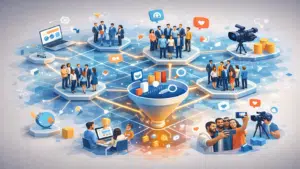
A successful marketing campaign does not start in the meeting room or from the designer’s genius; it begins in the “mind of the consumer.” In this section, we will deconstruct the concept of the audience from mere “numbers” into “human entities” with motivations and fears.
-
Audience Philosophy: Why Is It the Primary Driver?
In the past, marketing relied on “mass marketing,” where the message was broadcast to everyone with the goal of reaching the largest possible number. Today, however, the audience holds the power; they have tools to block ads, skip them, and search for alternatives.
The importance of the audience lies in three strategic pillars:
Spending Efficiency: Every riyal spent on an uninterested audience is direct waste. Understanding the audience means directing the budget only toward “fertile ground.”
Value Formulation: A product in itself has no value unless it solves a problem for someone. The audience determines the “nature” of this value.
Sustainability: Campaigns that focus on the audience build a “relationship,” while campaigns that focus only on the product create a single “sale” and then end.
-
Psychographic and Demographic Profiling of the Audience
To understand your audience deeply—not superficially—you must go beyond traditional data. Here is how professional audience profiling is done:
A. Demographic Data (The Outer Surface):
This is the basic information that gives us the “general framework”:
Age and Generation: Are you addressing “Gen Z,” who value speed and transparency, or “Baby Boomers,” who tend to be loyal to traditional brands?
Geographic Location and Culture: Language, dialect, and even climate influence purchasing decisions. A coat-selling campaign in Riyadh differs in timing and format from one in London.
Economic and Educational Level: This determines the “expectation ceiling” and the language used (simple or technically complex).
B. Psychographic Data (The Inner Core):
This is where the secrets lie that make a customer click the “Buy” button:
Values and Principles: Does your audience care about the environment? Sustainability? Social status?
Lifestyle: How do they spend their day? Are they “productivity-obsessed” or “comfort-seekers”?
Fears: What do they fear? (Missing out, losing money, social failure).
-
Building the “Buyer Persona” as an Execution Tool
After collecting data, we fuse it into a “Buyer Persona.” It is a fictional character representing a real segment of your audience.
Practical Example for Deeper Understanding: Imagine you are marketing a “task management” app. Instead of targeting “employees,” we build a persona called “Anxious Sarah”:
Description: A 32-year-old project manager working remotely.
Pain Point: She feels scattered due to the volume of email and WhatsApp messages and fears forgetting an important deadline.
Motivation: She wants to regain “peace of mind” and spend more time with her family without thinking about work.
Result: When writing your ad, you won’t say, “Our app organizes tasks.” Instead, you’ll say, “Sarah, reclaim your family peace and let us organize your schedule.” This is the difference between superficiality and depth.
-
The Audience and the Customer Journey
The audience is not a single block at the same stage. Its importance appears clearly when segmented by “level of awareness”:
Unaware of the problem: Needs educational content that opens their eyes to a gap.
Aware of the problem: Searching for solutions—here you must appear as the expert.
Comparing solutions: Needs social proof (reviews, case studies).
Ready to buy: Needs only a small push (offer, discount, guarantee).
The Audience as a Compass for Designing the Messaging Strategy
Once the “Buyer Persona” is defined, the most critical stage begins: how do we speak to them? The importance of the audience here lies in the fact that it dictates your words, your tone of voice, and even the colors and emotions your campaign should evoke.
-
Defining the Tone of Voice Based on Audience Psychology
Tone of voice is not what you say, but how you say it. The audience determines whether your tone should be:
Formal and authoritative: If your audience consists of C-level executives seeking efficiency and reliability.
Friendly and youthful: If your audience is “Gen Z,” who dislike formality and prefer smart slang or memes.
Inspirational and emotional: If you sell a product related to self-actualization or humanitarian causes.
Why is this important? Because audiences naturally gravitate toward those who resemble them. When you use language that reflects your audience’s culture, you break the “stranger” barrier and become a “trusted advisor,” instantly increasing trust.
-
Crafting a Unique Selling Proposition (USP) Tailored to the Audience
Many campaigns fail because they focus on product “features” rather than audience “benefits.”
Feature: “This computer has 32GB of memory.” (Cold technical language).
Audience Benefit: “Edit your complex videos in minutes without your device freezing.” (Language that touches a real need).
The audience determines which “benefit” matters most. A professional photographer cares about speed, while a student cares about price and battery life. A successful campaign strikes the “sensitive chord” for each audience segment.
-
Using Psychological Triggers
The audience is not a calculator but an emotional being that makes decisions based on psychological triggers defined by its type and interests:
Fear of Missing Out (FOMO): Highly effective with young, trend-following audiences.
Social Proof: Essential for hesitant audiences who need others’ reviews to feel safe.
Authority: Effective for audiences seeking medical or investment solutions, where they need to hear from an “expert.”
-
The Audience and Visual Identity Design
The importance of the audience extends beyond words to visuals. Colors and fonts must reflect the target audience’s taste:
Elite audience: Prefers calm colors, large white spaces, and minimalistic fonts.
Discount-oriented audience: Attracted to bold colors (red, yellow) and thick fonts that imply urgency.
Channel Selection and Customer Journey Mapping
Understanding the audience is not complete by knowing “who they are” and “what to say,” but also “where to find them” and how they move from stranger to loyal customer. Choosing the wrong channel means losing the message—even if it is brilliant.
-
Digital Presence Geography: Where Does Your Audience Live?
The audience dictates the platform, not the other way around. Budget distribution must follow the audience’s digital footprint:
B2B Audience: If your audience consists of company managers or professionals, LinkedIn is your main arena. Here, analytical content and in-depth studies are valued.
Young and Visual Audience: If your product relies on aesthetics (fashion, food, travel), Instagram and TikTok are ideal. This audience is drawn to fast, spontaneous, high-quality visual content.
Search-and-Solution Audience: If your audience seeks immediate solutions (e.g., repairs, legal consultations), Google Search (via SEO or SEM) is their starting point.
-
Mapping the Customer Journey
The importance of the audience becomes clear when we realize it is not a “point” but a “path.” Your campaign must accompany the audience at every stage:
Stage | Audience Behavior | Marketing Role
Awareness | Searching for general information or feeling a problem. | Provide educational content, introductory videos, awareness articles.
Consideration | Comparing solutions and competitors. | Provide comparisons, testimonials, webinars.
Decision | Ready to buy and seeking trust. | Offer limited-time discounts, guarantees, or free trials.
Loyalty | Purchased and seeking support. | “How-to” content, rewards, excellent customer service.
-
Analyzing Touchpoints
Every time the audience sees your brand is a “touchpoint.” Smart audiences expect consistency. If they see a “friendly” Facebook ad but find a “complex and formal” website, confusion arises and they withdraw. The audience forces you to unify the experience everywhere they encounter you.
The Audience in Marketing Campaigns
-
The Audience as a Driver of Campaign Timing
Understanding audience behavior determines when to launch your campaign. Are they “night owls” browsing after midnight? Or employees checking email early in the morning? Analyzing time-based data ensures your message appears in the “golden moment” when engagement is highest.

The Power of Data-Driven Insights and Understanding Real Audience Behavior
In modern marketing, intuition is no longer enough. The importance of the audience appears in the digital traces they leave behind; every click, every second of view time, and every exit is an encoded message. Your role is to decode it to improve your campaign.
-
From “Who Are They?” to “What Do They Do?” (Behavior Analysis)
Demographic data tells you identity, but behavioral data tells you the truth.
Clickstream Tracking: Where do they click? If they ignore “Buy Now” and focus on “Read More,” they need more information before deciding.
Bounce Rate: If they leave immediately, there is an “expectation gap” between the ad message and the page content.
-
A/B Testing: Let the Audience Decide
The importance of the audience lies in being the final judge. Instead of debating design preferences, use A/B testing:
Create two versions of an ad (change headline, color, or image).
Show them to two small audience segments.
Result: The higher-performing version gets the larger budget. You follow real audience taste—not your own.
-
Predictive Analytics
Using historical data, you can predict future behavior.
Example: If data shows purchases spike at month-end (after salaries), intensify campaigns then rather than spreading the budget evenly.
Churn Prediction: Data indicates when interest declines, allowing retargeting before customers leave completely.
-
Heatmaps and Browsing Psychology
Tools like Hotjar provide heatmaps of your site, showing where the audience’s mouse moves.
If attention focuses more on product images than price, then “quality and aesthetics” are key drivers and should be emphasized.
-
Social Listening
The audience talks about you (and competitors) outside official channels. Social listening tools reveal general sentiment. Are they angry about service? Praising a feature? This is a “gold mine” for campaign adjustment.
The Audience as a Source of Engagement and Organic Growth (The Advocacy Power)
At this level, we realize the audience is not the “end” of a campaign but its “beginning.” Its importance lies in amplifying impact without extra ad spend—by transforming from “consumer” to “brand advocate.”
-
Community Building, Not Just Followers
Superficial campaigns gather “followers”; deep campaigns build “community.”
In a community, the audience interacts with each other and the brand.
When they feel belonging, they defend you and generate ideas. A community member won’t leave for a small competitor discount.
-
User-Generated Content (UGC)
Audience power becomes productive force. A customer’s phone-shot video is 10 times stronger than studio content.
Why? Because audiences trust peers more than brands.
Encouraging sharing (via contests or hashtags) creates waves of social proof.
-
Feedback Loop as a Development Tool
The audience is your best free business consultant. By monitoring comments, complaints, and suggestions, you can:
Discover hidden product flaws.
Identify new needs for upselling.
Publicly responding to feedback builds massive trust by showing the “human” behind the logo.
-
The Organic Engine
When your campaign deeply touches audience needs, they talk about you privately and in WhatsApp groups. This trust-based marketing is priceless.
The strategy: Move from “satisfactory” to “delight” (Delight Phase), prompting spontaneous sharing.
Frequently Asked Questions (FAQ)
- How can I encourage my audience to create UGC for my brand? Start by honestly asking for their opinions, reposting their product photos on official accounts (making them feel appreciated), or launching contests for the best product photo/video.
- What if audience engagement is negative? Negative feedback is a golden opportunity. Handling issues quickly and professionally in public proves credibility. Audiences expect responsibility, not perfection.
- Can organic growth replace paid ads? Organic growth lowers customer acquisition cost (CAC) over time but works best alongside paid ads. Ads attract new audiences; organic growth retains and converts them into advocates.


No comment