
 النسخة العربيه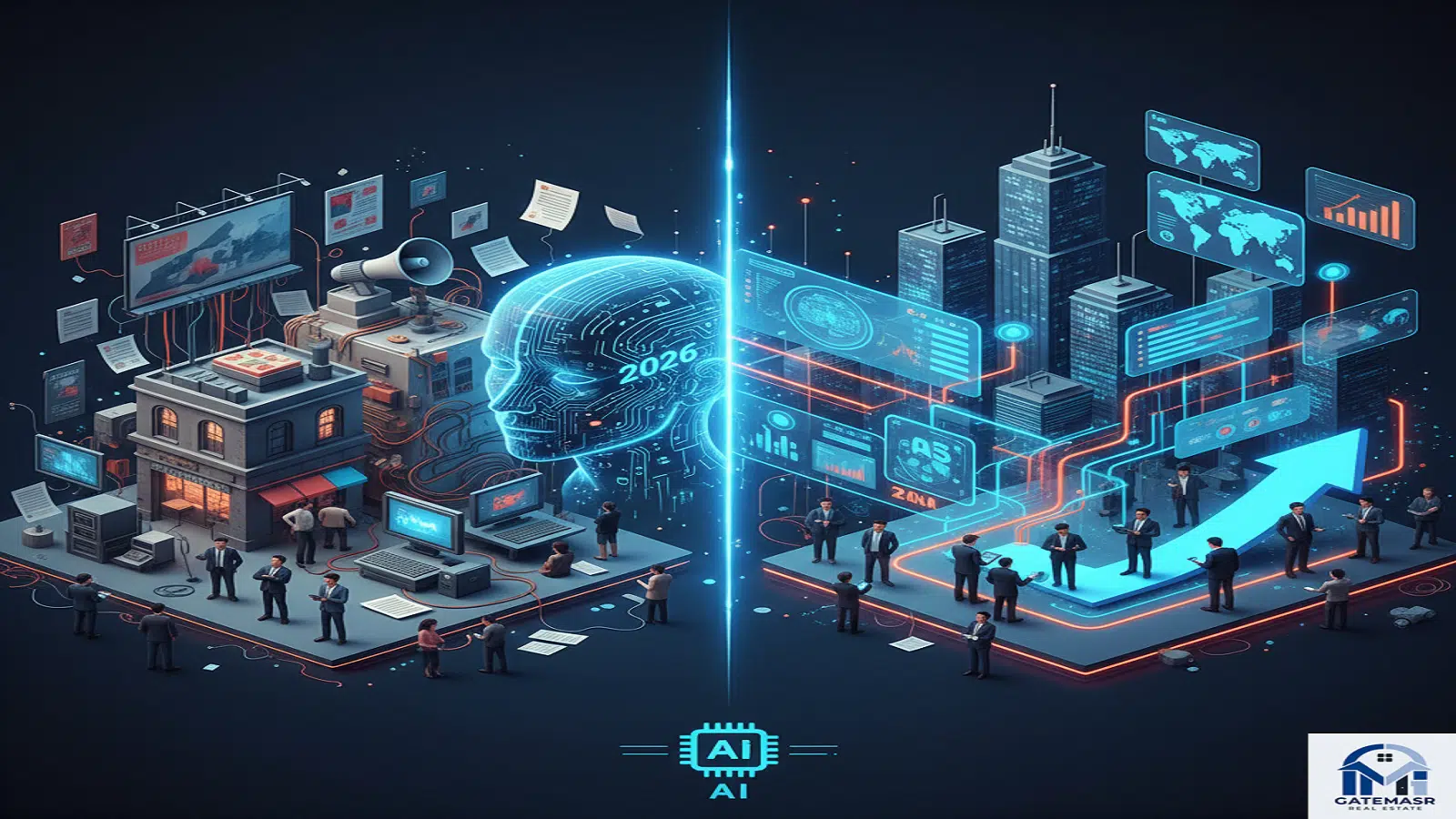
The Dawn of the AI-Native Era
As we navigate through 2026, the digital marketing landscape has reached a point of no return. We are no longer simply “using AI tools” to speed up tasks; we are operating in an AI-native ecosystem. The boundary between technology and strategy has blurred. For businesses, this means that the traditional “digital-first” mindset has been replaced by an “AI-first” mandate.
In this new paradigm, the velocity of change is unprecedented. What worked in 2024 is now considered “legacy marketing.” To stay relevant, brands must understand that AI is not just a feature—it is the very fabric of the internet.
From Search Engines to “Answer Engines”
One of the most significant shifts in 2026 is the transformation of search. For over twenty years, Google’s blue links were the primary gatekeepers of traffic. Today, we have moved into the era of Search Generative Experiences (SGE) and AI Overviews.
-
The Rise of AIO: Modern SEO is now AI Optimization (AIO). Instead of fighting for the #1 spot on a results page, marketers are optimizing their content to be the “source of truth” for AI models.
-
Zero-Click Reality: More users are getting their answers directly from the AI interface without ever clicking through to a website. This has forced brands to shift their KPIs from “Total Clicks” to “Brand Citations” and “Information Authority.”
Hyper-Personalization: The New Minimum Standard
In 2026, the “Average Consumer” no longer exists. AI allows us to treat every single customer as a segment of one.
-
Contextual Intelligence: AI now analyzes real-time data—such as current weather, a user’s immediate biometric stress levels (via wearables), and recent search intent—to deliver a message that feels intuitive rather than intrusive.
-
The End of Generic Content: If a consumer sees a generic ad in 2026, they don’t just ignore it; they lose trust in the brand. AI-native marketing ensures that the creative, the offer, and the timing are perfectly aligned with the individual’s current stage in the customer journey.
AI-Driven Content & Creative Strategy
The Explosion of Generative Media
By 2026, the barrier between an idea and a high-fidelity creative asset has virtually disappeared. Generative AI has moved beyond simple text prompts into Multimodal Orchestration. Marketers are now using AI to produce studio-quality video, bespoke music, and photorealistic imagery in seconds rather than weeks.
-
Dynamic Creative Optimization (DCO): In this era, an ad is no longer a static file. AI generates thousands of versions of a single video ad in real-time, adjusting the background, the spokesperson’s language, and even the product features shown based on the viewer’s specific profile.
-
Synthetic Influencers & Brand Ambassadors: We are seeing the rise of AI-generated brand personas that can interact with customers in live streams 24/7, providing a consistent brand voice that never sleeps and is entirely scalable.
Efficiency vs. Authenticity: The “Human-in-the-Loop” Necessity
While AI provides the “muscle” for content production, it often lacks the “soul.” In 2026, the market is becoming flooded with AI-generated noise. This has created a premium on Human Authenticity.
-
The Curator Role: The modern content creator has evolved into a “Creative Director” of AI. The human’s job is to provide the unique angle, the emotional depth, and the cultural nuance that algorithms cannot yet replicate.
-
Trust as a Currency: Consumers are developing an “AI-radar.” Brands that over-automate without human oversight risk looking robotic. The most successful strategies in 2026 use AI for the 80% of repetitive production, while humans provide the 20% of critical “spark” and emotional resonance.
Predictive Content: Knowing Before the Customer Does
The most advanced marketing teams in 2026 aren’t just reacting to trends; they are using Predictive Content Engines.
-
Trend Synthesis: AI models now analyze global data patterns—from social sentiment to supply chain shifts—to predict what topics will be “viral” next week. Marketers use these insights to have content ready before the conversation even starts.
-
Proactive Problem Solving: If the AI detects a pattern of customers struggling with a specific product feature, it can automatically generate and distribute “How-to” guides or video snippets to those specific users before they even think to contact support.
-
Data, Automation & Customer Experience
SEO Description: Master predictive analytics and AI-driven customer experiences in 2026. Learn how to navigate a cookieless world using first-party data and deploy intelligent chatbots that transform from simple tools into sophisticated sales agents.
Predictive Analytics: From Hindsight to Foresight
In the traditional digital era, marketers looked at “dashboards” to see what happened last month. In 2026, we look at “Forecast Engines.” Predictive analytics, powered by deep learning, has turned data into a crystal ball.
-
Churn Prediction: AI models now identify subtle patterns in user behavior—like a slight decrease in app open frequency or a change in support ticket tone—predicting which customers are about to leave weeks before they actually do.
-
LTV (Lifetime Value) Forecasting: Upon the very first interaction, AI can estimate the potential long-term value of a lead. This allows marketing teams to bid aggressively on high-value prospects while automating low-touch workflows for others.
AI Chatbots & Conversational Commerce 2.0
The frustrating, “I don’t understand that question” chatbots of the early 2020s are dead. In 2026, we use AI Sales Agents. These agents are powered by Large Language Models (LLMs) that have been fine-tuned on a company’s specific inventory, brand voice, and historical sales data.
-
Emotional Intelligence (EQ): Modern AI agents can detect frustration, hesitation, or excitement in a user’s text or voice. If a customer is hesitant about a price, the AI can dynamically offer a limited-time discount or a bundle to close the sale.
-
Full-Funnel Assistance: These agents don’t just answer FAQs; they guide the user through the entire journey—from product discovery and comparison to checkout and post-purchase setup—all within a single chat interface.
With the total phase-out of third-party cookies and heightened privacy regulations (GDPR 2.0), the “old way” of tracking users across the web has vanished. AI has become the primary solution for this data gap.
-
First-Party Data Enrichment: Brands now focus on collecting their own data (emails, purchase history, on-site behavior). AI then “fills in the blanks,” using probabilistic modeling to understand customer segments without violating individual privacy.
-
Privacy-Preserving Attribution: AI models can now accurately attribute a sale to a specific marketing campaign without needing to track a user’s every move. It analyzes “macro” signals to determine which creative assets are driving the most ROI.
The Ethical Frontier & SEO Evolution
SEO Description: Understand the critical importance of EEAT in the age of AI. Learn how to navigate algorithmic bias, maintain ethical transparency, and bridge the skills gap to become a successful AI Orchestrator in the 2026 digital marketing landscape.
EEAT in the AI Era: Why the “Human” Matters More Than Ever
In 2026, the internet is saturated with AI-generated content. To combat “content pollution,” search engines and AI discovery tools have doubled down on EEAT (Experience, Expertise, Authoritativeness, and Trustworthiness).
-
The Experience Premium: AI can synthesize facts, but it cannot “experience” a product or a service. Marketers are now focusing on “Evidence-Based Content”—using real-world photos, first-person reviews, and original case studies to prove to algorithms that a human was involved.
-
Verified Subject Matter Experts (SMEs): Having content “ghost-written” by AI is risky. In 2026, content must be vetted and “signed” by verifiable human experts. Digital signatures and blockchain-based authorship are becoming standard tools to verify that an expert actually backs the information provided.
Ethics, Transparency, and Algorithmic Bias
As AI takes the wheel, ethical considerations have moved from the HR department to the Marketing department. Brand reputation in 2026 is tied directly to how “responsibly” a company uses AI.
-
The Disclosure Mandate: Consumers now demand transparency. Whether it’s an AI-generated model in a fashion ad or a chatbot assisting with a loan, brands that fail to disclose AI involvement face a massive backlash in consumer trust.
-
Combating Bias: Marketers must actively audit their AI models. If an AI tool is trained on biased data, it might accidentally exclude certain demographics from seeing ads or offer different prices based on flawed logic. Ethical marketing in 2026 includes “Bias Auditing” as a standard part of every campaign launch.
The Skills Gap: Transitioning to “AI Orchestrators”
The most profound change in 2026 isn’t the technology—it’s the people. The job description of a “Digital Marketer” has been completely rewritten.
-
From Creators to Orchestrators: Marketers are no longer spending 8 hours writing a blog post. Instead, they spend that time “orchestrating” various AI agents—one for research, one for drafting, one for SEO, and one for distribution.
-
The Rise of Prompt Engineering & Logic: The core skill is no longer just “writing” or “designing”; it is the ability to communicate effectively with AI to get the desired output. Understanding the logic behind the tools is now more important than knowing how to use a specific software interface.
Conclusion & Future Outlook
The “Age of AI” in digital marketing is not a future destination; it is the current reality of 2026. The transition has been painful for those who resisted, but for the adaptive marketer, it has unlocked a level of creativity and efficiency that was previously unimaginable.
Success in this era requires a delicate dance: using the infinite scale of AI to handle the data, while doubling down on the finite, irreplaceable qualities of human emotion and ethics.


No comment