
 النسخة العربيه
The Complete Guide 2026: Product Marketing with SEO and Turning Silent Traffic into Consistent Sales
In today’s digital commerce world, launching an elegant online store and adding products to it is no longer enough to generate sales. With the skyrocketing costs of paid advertising (PPC ) on social media platforms and Google, relying on it alone has become a risky venture that eats into companies’ profit margins. This is where Product Marketing with SEO (Search Engine Optimization) emerges as the most powerful sustainable digital asset businesses can invest in.
At Circle Aims , as a leading digital marketing agency, we see every day how the right SEO strategy can transform an online store from a state of stagnation into one that ranks on the first pages of search results and generates a steady flow of profits automatically, at lower costs over the long term.
In this comprehensive strategic guide, we will reveal in detail, with practical steps and figures, how to dominate search results with your products in 2026.
By the Numbers: Why Is SEO the Lifeblood of Product Marketing?
Before we dive into the technical details, let’s look at the current digital landscape through the language of documented figures and statistics for 2026:
- The primary gateway to sales : The latest studies indicate that 68% of online shopping experiences begin with a search engine. If your products are not among the top results, you are simply invisible to two-thirds of your potential customers.
- Higher trust and more clicks: The first organic result on Google alone captures approximately 30% of all clicks (CTR ), making it 10 times more likely to receive a click than the tenth result on the first page.
- The alternative cost: On average, ecommerce brands that rank at the top of search engines generate free monthly traffic that would cost more than $15,000 per month if purchased through paid advertising.
- The artificial intelligence revolution (AI Overviews ): With Google’s latest updates, AI-generated answers have caused a decline in clicks on traditional organic links. However, statistics confirm that websites cited and mentioned within AI Overviews achieve a 35% increase in clicks! This is what we focus on in our strategy at Circle Aims.
You cannot build a palace on unstable ground. Technical SEO is the foundation that allows search engine crawlers (and AI tools) to access your website, read it, and understand what you sell. Here are the essential technical pillars for product pages:
1. Website Speed and Targeted User Experience
Speed is no longer a luxury; it is a direct ranking factor and a decisive element in driving sales.
- The digital reality: Current statistics have shown that online stores that load in one second have a conversion rate 2.5 times higher than websites that take 5 seconds to load.
- Every additional one-second delay in loading a product page results in a loss of 7% of potential sales.
- Circle Aims Tip: Use modern image formats such as WebP, minify your code (CSS & JS), and ensure that your website’s Core Web Vitals scores are in the green range.
2. Addressing the Duplicate Content Problem with Canonical Tags
Online stores typically contain hundreds or thousands of products that are similar in color, size, or category. This similarity creates what is known as “Duplicate Content,” which confuses Google.
- Data shows that 53% of online stores lack canonical tags, which disperses indexing power across similar pages.
- The solution: The
rel="canonical"tag must be implemented on similar product pages to direct search engines to the original, primary version of the product that you want indexed and ranked at the top.
3. Full Mobile Compatibility (Mobile-First Indexing)
Google has been indexing websites based on their mobile versions first for years, and in 2026, the percentage of traffic coming from mobile devices to online stores has reached 68%.
- Surprisingly, mobile cart abandonment rates reach 85.7% due to poor user experience (UX) design.
- Make sure the “Add to Cart” button is clearly visible and that the checkout process is flexible and does not require filling out dozens of complicated fields on a small mobile screen.
Smart Keyword Research for Products (Ecommerce Keyword Research)
The fatal mistake most stores make is targeting keywords that are too broad and have nearly impossible competition, such as “shoes.” A consumer searching for “shoes” is still browsing and evaluating options, while someone searching for “black Nike running shoes size 42” is holding their credit card and is ready to buy immediately.
1. Focus on Long-Tail Keywords
- More than 50% of current searches consist of 4 words or more.
- Long-tail keywords have very high purchase intent (Transactional Intent) and a conversion rate three times higher than broad keywords, in addition to having lower competition.
2. Mapping User Search Intent
Keywords in product marketing are divided into:
- Informational intent: Such as “How to choose the best camera?” (targeted through the blog).
- Commercial intent: Such as “Canon vs. Sony camera comparison” (targeted through comparison articles).
- Transactional intent: Such as “Buy Canon R5 camera at the lowest price” (targeted directly on the product page).
A Golden Rule from Circle Aims: To succeed in marketing your products, your website structure must reflect the entire customer journey, from the awareness stage on the blog to the decision-making stage on the product page.
Welcome back. Here is Part Two of the comprehensive Circle Aims guide, where we will move on to the details of optimizing product pages internally (On-Page SEO) and strategies for creating sales-driven content that both Google and customers love.
On-Page SEO for Product Pages: Writing That Sells and Ranks
Once customers and search engine crawlers enter your product page, the actual evaluation process begins. In this section, we will explain how to transform an ordinary product page into a sales machine that fully complies with Google’s standards for 2026.
1. Crafting Attractive and Optimized Product Title Tags
The page title is the first thing searchers see on Google. Traditional titles such as “Cotton Shirt” will not give you any competitive advantage.
- The successful strategy: The title should include: BrandBrand + ProductNameProduct Name + MainFeature/Model/ColorMain Feature/Model/Color + Keyword.
- Professional example: Instead of “Smartwatch,” make it: “Xiaomi Mix 5 Smartwatch – Water-Resistant with AMOLED Display.”
- Important statistic: Titles that contain precise details (such as color or model) achieve an 18% higher click-through rate (CTR) than vague, generic titles.
2. Unique Product Descriptions and Avoiding Supplier Content
One of the biggest mistakes we notice at Circle Aims when reviewing online stores is copying and pasting product descriptions directly from supplier websites (such as AliExpress or Amazon).
- Google’s dilemma: When Google sees the same description repeated across 50 other stores, it will not give your store any indexing priority and may even consider it low-quality content.
- Solutions for 2026: Write a unique description from the perspective of the product’s benefits to the customer, rather than focusing only on its technical specifications.
- Write a short, engaging paragraph (50–100 words) explaining the problem the product solves.
- Use bullet points to present the main features for easy reading and scanning (Scannability).
- Current studies indicate that pages containing customized descriptions written in a unique, human style increase dwell time by 40%, which is a very strong signal to Google for improving your rankings.
3. Image and Video SEO
Customers in an online store buy with their eyes first. But Google is blind; it does not see images, but rather reads the code associated with them.
- Smart Alt Text: Do not leave the alt text field empty, and do not fill it with random keywords (Keyword Stuffing). Write an accurate description of what the image contains (example:
alt="Black Xiaomi Mix 5 smartwatch on a wrist"). - Video is king: Adding a 30-second video showcasing the product (unboxing or a demonstration of how to use it) increases conversion rates by up to 80% and makes your page eligible to appear in Google’s video search results (Video Carousel).
Schema Markup and the Magic of Rich Snippets
Have you ever noticed that some Google search results display rating stars, product prices, and stock availability beneath them? These are rich snippets generated by implementing Structured Data / Schema.
HTML
HTML
<script type="application/ld+json">
{
  "@context": "https://schema.org/",
  "@type": "Product",
  "name": "Xiaomi Mix 5 Smartwatch",
  "image": "https://circleaims.com/image.jpg",
  "description": "The latest Xiaomi smartwatch with an AMOLED display and water resistance.",
  "offers": {
    "@type": "Offer",
    "priceCurrency": "USD",
    "price": "99.00",
    "availability": "https://schema.org/InStock"
  }
}
</script>
Why Is Schema Your Secret Weapon in 2026?
- Attracting visual attention: Results that contain star ratings and prices immediately catch the searcher’s eye among dozens of other links.
- Increasing CTR: Statistics confirm that correctly implementing “Product Schema” increases click-through rates by 20% to 30%.
- Feeding Google’s AI: New AI Overviews technologies rely on structured data to understand your product prices and availability, giving your store a golden opportunity to appear as a leading recommendation within AI-generated answers.
Website Structure and Internal Linking Architecture
The way you organize folders and categories in your store determines how easily Google’s crawlers can navigate it. The most powerful strategy for ecommerce is the Silo Structure, or the hierarchical structure used by major international stores.
The Ideal Store Structure:
– Home Page
- ← Category Pages such as: (Electronics)
- ← Sub-Category Pages such as: (Smartwatches)
- ← Product Pages such as: (Xiaomi Mix 5 Smartwatch)
- ← Sub-Category Pages such as: (Smartwatches)
The Power of Internal Links
Do not leave your product pages isolated. Use internal links to connect products to one another and to your website’s blog posts:
- “Related Products” section: Helps customers navigate and distributes indexing power (Link Juice) evenly across your website’s pages.
- Linking from the blog: When you write an article on your store’s blog about “The 5 Best Smartwatches for 2026,” include a direct link to the Xiaomi smartwatch purchase page within the article. This link tells Google that this product page is extremely important.
Ecommerce Blogging: The Hidden Sales Magnet
Many store owners believe that a blog is a useless digital luxury, and this is one of the biggest strategic mistakes. Product pages naturally target direct transactional keywords with fierce competition, while a blog allows you to capture customers at earlier stages of their buying journey (the awareness and comparison stages).
1. Capturing Customers Before They Decide to Buy
- Documented statistics: Companies and stores with active, optimized blogs receive 434% more traffic compared to websites that do not blog.
- How to implement it: If you sell skincare products, competing for the keyword “collagen face cream” will be very difficult at first. However, when you write an article titled “Your Complete Guide to Treating Skin Wrinkles in Your 30s,” you attract thousands of women who suffer from this problem. Within the article, you recommend your store’s “collagen cream” as an ideal solution. This is how your blog becomes a highly effective Sales Funnel.
2. Building E-E-A-T (Experience, Expertise, Authoritativeness, and Trustworthiness)
Google’s 2026 updates focus strictly on evaluating website trustworthiness, especially for online stores that deal with users’ money and health (the Your Money or Your Life – YMYL category).
– When your blog provides rich content, usage guides, and expert advice, Google classifies your store as an “authority” in your industry, automatically improving your product pages’ rankings.
Link Building for Product Pages
Backlinks are like “votes of confidence” from other websites to yours. In ecommerce SEO, link building is a challenge because other websites do not like linking directly to sales pages; instead, they prefer linking to useful content.
How Does Circle Aims Overcome This Challenge?
- The Middleman Strategy: We build strong backlinks pointing to outstanding educational blog articles (which are easier to earn backlinks for because of their informational value), then pass this indexing power (Link Juice) to product pages through smart internal linking.
- Influencer Marketing and Digital PR: Send samples of your products to bloggers and reviewers in your industry so they can write honest reviews of your products on their websites, including a link to your store.
- A crucial statistic: Data confirms that the number of unique referring domains linking to your website remains the strongest correlation factor with rankings in Google’s top search results.
Smart Management of Out-of-Stock and Discontinued Products
Inventory changes and products going out of stock are everyday occurrences in ecommerce. However, the way you handle these pages can destroy your website’s SEO if done incorrectly.
The Correct Scenarios for Handling This Problem:
- Temporarily Out of Stock: Never delete the page or turn it into a 404 error.
- Leave the page as it is, replace the “Add to Cart” button with a “Notify Me When Available” option via email or WhatsApp, and suggest alternative products at the bottom of the page. This preserves the page’s Google ranking and ensures you do not lose the customer.
- Permanently Discontinued:
- If the page has strong traffic and backlinks, implement a 301 Redirect to the newer alternative product or to the main product category.
- If the page has no traffic or backlinks, you can let it return a 410 (Gone) error to inform Google that it has been permanently removed from the index, saving your Crawl Budget.
Summary Table: Your 2026 SEO Product Marketing Action Plan
To help you organize your work, we at Circle Aims have summarized the essential steps in this table so you can implement them immediately:
|
Strategic Stage |
Key Action |
Expected and Targeted Impact |
|---|---|---|
|
Technical SEO |
Optimize loading speed to under two seconds and ensure full mobile compatibility. |
Increase conversion rates and reduce Bounce Rate. |
|
Keyword Research |
Focus on long-tail keywords with high purchase intent (Transactional Intent). |
Attract visitors who are ready to buy immediately and reduce advertising costs. |
|
On-Page SEO |
Write unique and exclusive product descriptions, and optimize alt text for images and videos. |
Stand out from competitors and avoid Google’s duplicate content penalties. |
|
Structured Data |
Implement Product Schema (prices, star ratings, availability). |
Increase CTR by up to 30% and appear in AI Overviews. |
|
Content SEO |
Activate the blog to publish buying guides and product comparisons. |
Build website authority (E-E-A-T) and capture customers at the awareness stage. |
|
Link Building |
Earn strong backlinks through Digital PR and linking from the blog. |
Increase Domain Authority and rank at the top for difficult keywords. |
SEO Is the Investment That Never Stops Giving
Product marketing with SEO is not a button you press to generate profits the next day. It is like planting a fruit-bearing tree; it requires effort, expertise, and the right strategy at the beginning. But once it grows, it will provide your store with a continuous, free flow of customers who are ready to buy, around the clock, without paying a single penny for each click.
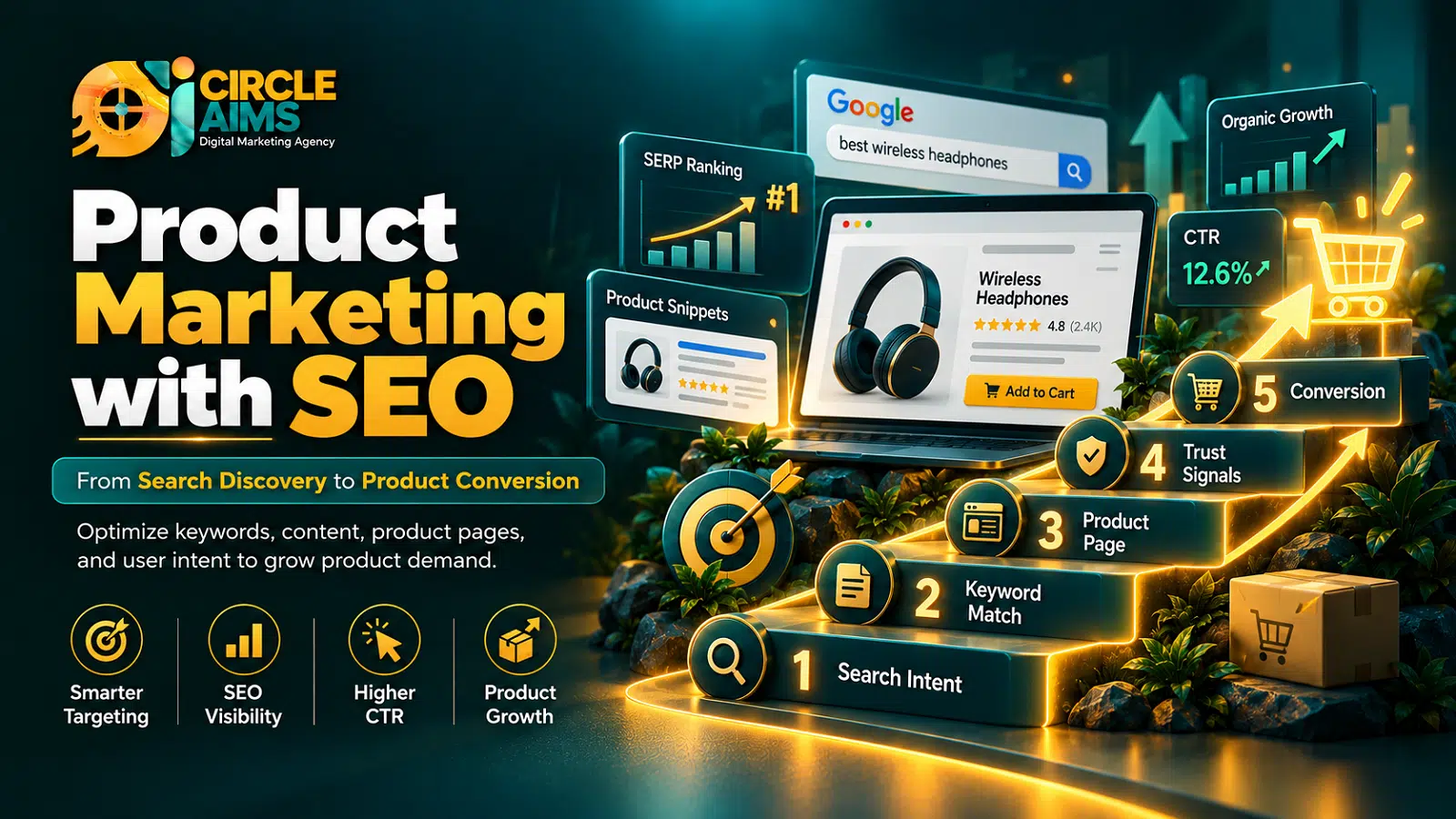
In the age of artificial intelligence and constantly changing search algorithms in 2026, you need a partner who understands these complex rules and creates a customized strategy for your store, allowing you to outperform competitors and rank at the top of search results.
Are you ready to turn your online store into a non-stop sales machine?
Contact us today at Circle Aims. Let us review your website technically and map out your roadmap to digital leadership!


No comment